Common Mistakes to Avoid in IT Job Interviews
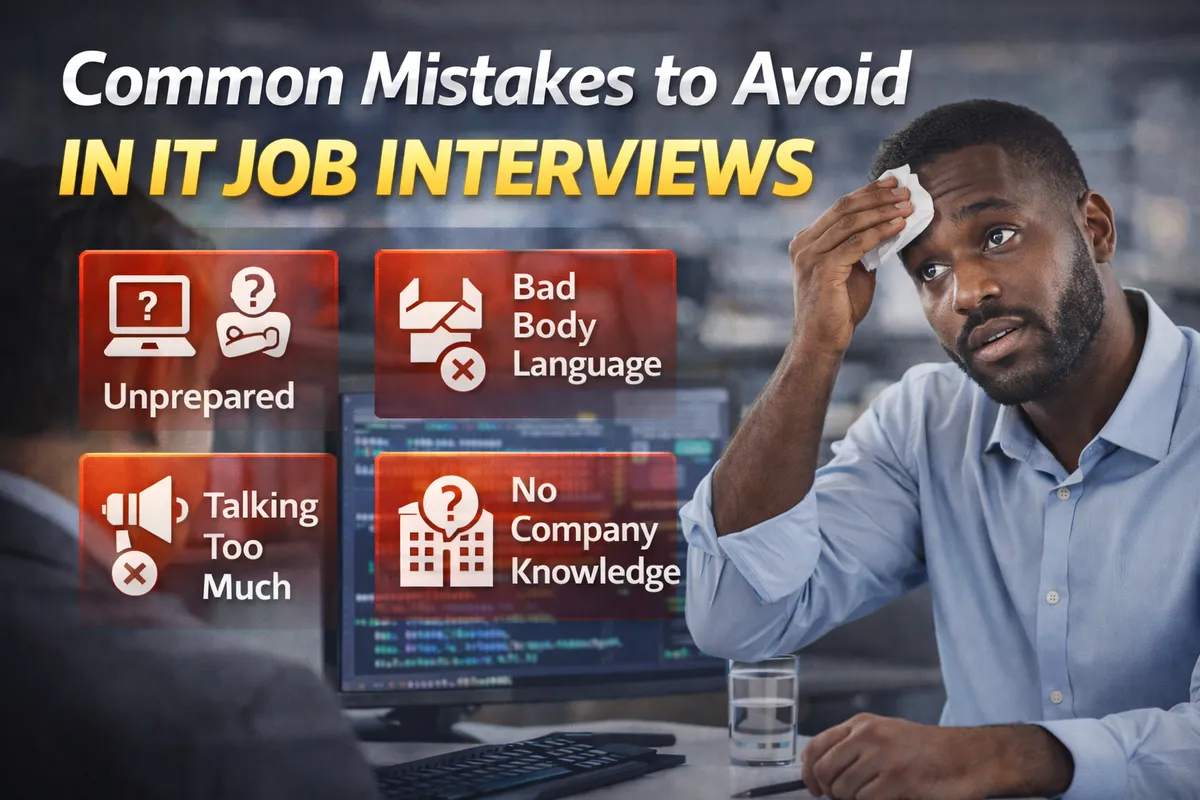
Hiring managers make up their minds fast. Research shows that 69.5% of interviewers form their decision within the first five minutes of an interview. And the most common reason candidates fail? It is not a lack of technical ability. According to a LinkedIn study, 47% of candidates are rejected because they show insufficient knowledge about the company they are applying to.
The truth is that most interview mistakes are predictable and preventable. Whether you are a junior developer walking into your first onsite or a senior engineer interviewing for a staff position, the errors that cost offers tend to be the same ones repeated across thousands of interviews every year.
This guide breaks down the most damaging mistakes IT candidates make and, more importantly, how to avoid each one.
The Mistakes That Cost You Before You Even Speak
You have roughly seven seconds to make a first impression. That is not a motivational quote. It is backed by research on how quickly interviewers form initial judgments based on nonverbal cues.
Body language plays a massive role. A CareerBuilder study found that 67% of hiring managers say failure to make eye contact is the most common nonverbal mistake candidates make. The same study reported that 38% of hiring managers pay close attention to posture, and 26% have skipped hiring candidates who fidgeted too much.
The most frequent nonverbal errors include:
- Avoiding eye contact, which signals discomfort or dishonesty
- Slouching or leaning back, which suggests low energy or disinterest
- Crossing your arms, which creates a defensive impression
- Fidgeting with objects, tapping fingers, or bouncing a leg, which distracts interviewers and signals anxiety
Dress also matters more than many tech candidates assume. A survey found that 71% of employers have cited inappropriate attire as a reason for rejection. You do not need a suit for most IT interviews, but looking polished and intentional signals that you take the opportunity seriously.
The fix is simple: practice walking into a room, making eye contact, sitting with an open posture, and greeting your interviewer with genuine confidence. These things can be rehearsed.
Walking In Unprepared
This is the single most common mistake in IT interviews, and it takes many forms.
A TopInterview survey found that 70% of hiring managers identify lack of preparation as a frequent candidate error. That includes not knowing what the company does, not understanding the role, and not being ready for predictable questions.
In IT specifically, preparation goes deeper than reading the "About Us" page. You should know:
- The company's product or service and who their users are
- The tech stack listed in the job posting and how it relates to your experience
- Recent company news, such as funding rounds, product launches, or engineering blog posts
- The interview format, including whether to expect a coding round, system design, or take home assignment
Only 54% of candidates research the company before walking into an interview, according to Indeed's 2024 Workforce Insights Report. That means nearly half of all candidates show up without doing basic homework. Standing out here requires minimal effort with outsized returns.
A practical approach: spend 30 minutes the night before reviewing the company website, their engineering blog if they have one, recent LinkedIn posts from the team, and the specific job listing. Write down two or three thoughtful questions that show you understand what they are building.
Communication Pitfalls During the Interview
Technical knowledge alone does not win interviews. How you communicate that knowledge does.
According to CareerBuilder, the most common communication mistakes candidates make include not asking questions (38%), talking too much (33%), and appearing disinterested (32%). Each of these sends the wrong message.
Talking Too Much or Too Little
Rambling through answers dilutes your key points and loses the interviewer's attention. On the other hand, giving minimal one sentence responses makes it impossible for them to evaluate your depth. The goal is structured, concise responses that directly address the question.
For technical questions, narrate your thought process out loud. Interviewers want to understand how you think, not just what you know. Saying "I am considering a hash map here because we need constant time lookups" is far more valuable than silently writing code.
Not Asking Questions
When the interviewer asks "Do you have any questions?" saying "No, I think you covered everything" is a missed opportunity. It signals low interest. Prepare at least two or three thoughtful questions about the team, the technical challenges they face, or how they approach engineering decisions.
Criticizing Past Employers
This is a bigger red flag than most candidates realize. A Harvard Business Review survey of 625 hiring managers found that 31% view criticism of former employers or colleagues as a significant red flag, second only to dishonesty. Even if your last job was genuinely terrible, frame your departure around what you are looking for, not what you are running from.
Technical Round Blunders
The technical interview is where preparation meets execution, and where several specific mistakes repeatedly cost candidates.
Jumping Straight Into Code
One of the biggest red flags for technical interviewers is when a candidate starts writing code immediately without asking clarifying questions. Before touching the keyboard, you should confirm input constraints, expected output format, edge cases, and whether optimizing for time or space is more important.
Taking 60 seconds to clarify the problem can save you from building the wrong solution entirely.
Not Testing Your Solution
Many candidates declare "I am done" without walking through their code with a sample input. This skips the exact step that catches off by one errors, null pointer issues, and boundary condition bugs. Always trace through at least one example manually before presenting your solution as complete.
Ignoring Time and Space Complexity
In 2025, interviewers expect candidates to analyze and articulate the complexity of their solutions. Simply providing a working answer is no longer sufficient. Companies now require candidates to demonstrate understanding of algorithmic tradeoffs. Be prepared to state your solution's Big O complexity and discuss how it could be optimized.
Underestimating System Design
For mid level and senior candidates, system design rounds have become significantly more rigorous. Candidates are now expected to discuss distributed systems concepts, database scaling strategies, caching layers, and load balancing with the depth previously expected only at staff level. According to Levels.fyi 2025 data, 63% of senior candidates receive downleveled offers, partly because system design performance does not meet elevated expectations.
Ignoring the Behavioral Round
Many IT candidates treat behavioral interviews as a formality. This is a costly miscalculation.
Research shows that 90% of hiring managers consider soft skills as important as technical skills. Behavioral questions are used by approximately 73% of employers, and studies indicate they are 55% effective at predicting actual job performance, compared to just 10% for traditional interview questions.
The most common behavioral interview mistakes include:
- Giving generic answers like "I am a team player" without a specific example
- Using "we" instead of "I", making it unclear what your personal contribution was
- Not preparing stories in advance, leading to rambling, unfocused responses
- Skipping the result, ending your answer without quantifiable outcomes
The STAR method (Situation, Task, Action, Result) provides a reliable structure. Prepare three to five stories from your career covering themes like conflict resolution, tight deadlines, technical disagreements, and learning from failure. These stories can be adapted to fit a wide range of behavioral questions.
Dishonesty is the number one red flag across all surveys. A Harvard Business Review study found that 63% of hiring managers rank it as their top concern. In a world where 44% of candidates admit to lying during the hiring process (Resume Builder, January 2025), interviewers are actively looking for inconsistencies. Authenticity and specific, honest examples will always outperform embellished stories.
The Post Interview Mistakes Nobody Talks About
The interview does not end when you walk out of the room.
Not Sending a Thank You Email
A TopResume survey found that 68% of hiring managers say receiving a thank you note influences their decision. Nearly one in five interviewers have dismissed a candidate entirely for not sending one. Despite this, 57% of candidates never send a follow up message.
A brief, personalized email sent within 24 hours can reinforce your interest, reference a specific topic from the conversation, and demonstrate professionalism. It does not need to be elaborate. Three to four sentences are enough.
Not Learning from Rejection
Rejection is part of the process, especially in tech. The candidates who improve fastest are those who treat each interview as a learning opportunity. After every interview, write down:
- Which questions caught you off guard
- Where your communication could have been clearer
- What technical topics you need to review
- What you did well and should continue doing
Look for patterns across multiple interviews. If you consistently struggle with dynamic programming or system design estimation, that tells you exactly where to invest your preparation time.
Turning These Mistakes Into Strengths
Every mistake on this list is fixable with awareness and practice. Here is a pre interview checklist you can use:
The night before:
- Research the company's product, tech stack, and recent news
- Review the job description and map your experience to their requirements
- Prepare your STAR stories for behavioral questions
- Choose professional attire
The morning of:
- Review your notes on the company
- Prepare two to three questions for the interviewer
- Practice your introduction and opening handshake
- Arrive 10 minutes early or test your video setup for remote interviews
During the interview:
- Make eye contact and maintain open body language
- Ask clarifying questions before solving technical problems
- Think out loud during coding challenges
- Test your solutions before declaring them complete
After the interview:
- Send a personalized thank you email within 24 hours
- Write down what went well and what needs improvement
- Identify specific areas to practice before your next interview
The most effective way to eliminate these mistakes is to practice in conditions that simulate the real thing. Mock interviews expose blind spots that solo preparation cannot reveal, from communication habits to time management under pressure.
Skill2Offer provides role specific mock interviews with structured feedback covering technical questions, behavioral rounds, and communication coaching for IT roles at every level. When interview day arrives, the format should feel familiar, not intimidating.
The mistakes that cost most candidates are not mysteries. They are patterns. And patterns can be broken with the right preparation.
Stay in the Loop
Get the latest interview tips, career advice, and IT insights delivered straight to your inbox.
Related Articles
How to Ace Your Technical Interview: A Complete Guide
Only 20% of candidates get an offer after an interview, and most engineers fail their first 4 to 5 onsites. This guide breaks down exactly how to prepare, practice, and perform on interview day.