How to Ace Your Technical Interview: A Complete Guide

The average success rate for job interviews sits at roughly 20%. That means four out of five candidates walk away without an offer. In technical interviews specifically, the numbers are even more sobering: most engineers fail their first four to five onsite interviews before landing a single offer, according to data from Triplebyte.
These numbers are not a reflection of talent. They reveal a preparation gap. The good news is that this gap can be closed with the right strategy, consistent practice, and a clear understanding of what interviewers actually evaluate.
This guide covers everything you need to know to walk into your next technical interview with confidence and walk out with an offer.
The Technical Interview Landscape in 2025
The hiring bar in tech has never been higher. Big Tech hiring volumes are up roughly 40% year over year, but companies have simultaneously raised their standards. It is no longer enough to provide a working solution during a coding round. Interviewers now expect comprehensive implementations with proper error handling, input validation, and clean code.
A few key data points paint the picture:
- A typical job posting attracts around 250 resumes, and only 4 to 6 candidates get called for an interview
- The average time to hire has stretched to 44 days, up significantly from pre-pandemic timelines
- 90% of hiring managers say soft skills are just as important as technical skills
- Frontend and backend roles have dropped 22% since 2022, while AI roles have surged
The takeaway: competition is fierce, the process is longer, and employers are pickier than ever. Preparation is not optional.
Why Qualified Candidates Still Fail
Here is the uncomfortable truth: being good at your job does not automatically make you good at interviewing for one. According to HackerRank's Developer Skills Report, 69% of developers feel inadequately prepared for coding interviews despite having the skills to do the job.
The most common reasons qualified candidates fail include:
- Insufficient practice under pressure. A survey by Hired.com found that 43% of candidates are rejected due to insufficient technical skills, often not because they lack knowledge, but because they have not practiced applying it in timed, high pressure interview settings.
- Poor communication. Knowing the answer is not enough. Candidates who cannot articulate their thought process clearly, explain tradeoffs, or walk through their reasoning out loud consistently underperform.
- Neglecting the behavioral round. Top tech companies assign significant weight to behavioral interviews, especially for senior roles. Generic answers without specific personal examples are a red flag.
- No company research. More than 60% of candidates fail to demonstrate meaningful understanding of the company's products, values, and challenges, according to hiring managers at leading tech companies.
- Overconfidence. Experienced developers with 10 or 15 years of experience sometimes assume their resume speaks for itself. Interview questions are fundamentally different from day to day programming tasks.
Recognizing these failure patterns is the first step toward avoiding them.
Building Your Technical Foundation
Data Structures and Algorithms
Every technical interview, from startups to FAANG, tests your ability to solve problems using fundamental data structures and algorithms. The core areas to master include:
- Arrays, strings, hash maps, and sets
- Linked lists, stacks, and queues
- Trees (binary trees, BSTs, tries) and graphs
- Sorting and searching algorithms
- Recursion, dynamic programming, and greedy algorithms
The key is not to memorize solutions. Focus on recognizing patterns across problems. When you understand why a sliding window works for substring problems, you can adapt that pattern to dozens of variations.
How many problems should you solve? Data from engineering interview studies suggests that successful junior candidates typically solve between 150 and 200 coding problems before interviewing. For mid level and senior engineers, the number is lower, but the depth per problem is greater.
System Design
For mid level and senior roles, system design interviews have become more rigorous and structured. You will be expected to design scalable systems and discuss tradeoffs around databases, caching, load balancing, and distributed architecture.
Study the architecture of real systems like Twitter, Netflix, or Uber. Practice explaining your design choices out loud, covering scalability, consistency, performance, and maintainability.
Realistic Preparation Timelines
- Junior engineers: 1 to 3 months to build fundamentals from scratch
- Mid level engineers: 2 to 4 weeks to sharpen existing skills and add system design
- Senior engineers: A few focused weeks on system design, leadership scenarios, and communication
These timelines assume daily practice of 1 to 2 hours. Consistency beats cramming every time.
The Behavioral Round: Your Secret Weapon
Many candidates treat behavioral interviews as an afterthought. This is a mistake. Behavioral interviews are used by approximately 73% of employers, and research shows they are 55% effective at predicting actual job performance, compared to only 10% for traditional interview questions.
The STAR Method
The most effective framework for answering behavioral questions is STAR:
- Situation: Set the scene with a specific context from your experience
- Task: Explain what you were responsible for
- Action: Describe the specific steps you took (use "I" not "we")
- Result: Share the measurable outcome of your actions
A Concrete Example
Question: "Tell me about a time you had to meet a tight deadline."
Weak answer: "I always work well under pressure and meet my deadlines."
Strong STAR answer: "Our team was building a payment integration and the third party API changed their authentication flow two weeks before launch (Situation). I was responsible for the backend integration (Task). I set up a parallel branch, rewrote the auth module using their new OAuth flow, added retry logic, and wrote integration tests in three days. I also documented the changes for the frontend team so they could adapt simultaneously (Action). We shipped on time with zero payment failures in the first month (Result)."
Preparation Strategy
Prepare 3 to 5 detailed stories from your career that cover common themes: conflict resolution, tight deadlines, technical disagreements, leadership, and failure. These stories can be adapted to answer a wide variety of behavioral questions. Write bullet point outlines rather than scripts so your delivery stays natural.
The Power of Mock Interviews
If there is one piece of advice that moves the needle more than anything else, it is this: do mock interviews.
Data from Interviewing.io shows that completing five technical interviews, whether mock or real, doubles your chances of passing a subsequent technical interview. The key is that these practice sessions must simulate real conditions as closely as possible.
Research published in the Journal of Engineering Education Transformations found that candidates who practiced with AI powered mock interview platforms improved by over 30% across technical correctness, communication clarity, and response structure.
Why Mock Interviews Work
- They reduce anxiety by making the format familiar
- They expose blind spots in your problem solving approach
- They force you to practice communicating your thoughts out loud
- They provide feedback loops that solo practice cannot replicate
Studies by Wilkie and Rosendale (2024) confirmed that students reported increased preparedness and significantly reduced anxiety after mock interview practice. Combining mock interviews with reviewing recorded performances amplifies the learning effect.
Practicing alone with LeetCode is valuable, but it does not replicate the pressure of explaining your approach to another person in real time. Mock interviews bridge that gap.
Interview Day: Tactical Tips
The First Five Minutes Matter
Research shows that 49% of employers form their opinion about a candidate within the first five minutes of an interview. This means your opening impression, including how you greet the interviewer, your body language, and your initial responses, carries outsized weight.
Start by being genuine and engaged. A simple "I have been looking forward to this conversation" is more effective than rehearsed enthusiasm.
During the Coding Round
-
Ask clarifying questions before writing code. One of the biggest red flags for interviewers is when a candidate jumps straight into coding without understanding the constraints. Ask about input size, edge cases, and expected output format.
-
Think out loud. Interviewers want to see your reasoning process, not just the final answer. Narrate your approach: "I am thinking of using a hash map here because we need O(1) lookups."
-
Start with a brute force solution. Get a working approach first, then optimize. A correct brute force solution is always better than an incomplete optimal one.
-
Test your code. Walk through your solution with a sample input before saying you are done. Check for off by one errors, null cases, and boundary conditions.
Managing Stress
Interview anxiety is normal and affects even experienced engineers. Three techniques that help:
- Reframe the interview as a conversation, not an exam. You are discussing technical problems with a peer.
- Pause before answering. Taking 5 to 10 seconds to think is expected and shows composure.
- Prepare for getting stuck. If you hit a wall, say so: "I am stuck on this part. Let me think about what data structure would help here." Interviewers appreciate transparency over silent struggling.
Learning from Rejection
Rejection is part of the process. Triplebyte's data shows that engineers have roughly a 40% chance of getting an offer after their first onsite, but that number climbs to 80% by their fifth. The engineers who succeed are not necessarily smarter. They learn from each round.
After every interview, write down:
- Which questions you struggled with and why
- Where your communication broke down
- What topics you need to review
- What went well that you should keep doing
Look for patterns across multiple interviews. If you consistently struggle with dynamic programming or system design estimation, that tells you exactly where to focus your next preparation cycle.
The candidates who treat each rejection as data rather than defeat are the ones who eventually break through.
Start Practicing Today
Acing a technical interview is not about genius. It is about deliberate, structured preparation: building your technical foundation, practicing under realistic conditions, preparing your behavioral stories, and learning from every attempt.
If you are looking for a structured way to practice, Skill2Offer offers role specific mock interviews with detailed feedback, covering technical questions, behavioral rounds, and communication coaching for IT roles at every level. It is built to simulate the real thing so that interview day feels familiar, not frightening.
The best time to start preparing was a month ago. The second best time is right now.
Stay in the Loop
Get the latest interview tips, career advice, and IT insights delivered straight to your inbox.
Related Articles

What Google Recruiters Will NEVER Tell You
Google rejects over 99% of applicants. But it is not a lack of talent that explains most rejections. It is a lack of understanding of how the system actually works behind the scenes.
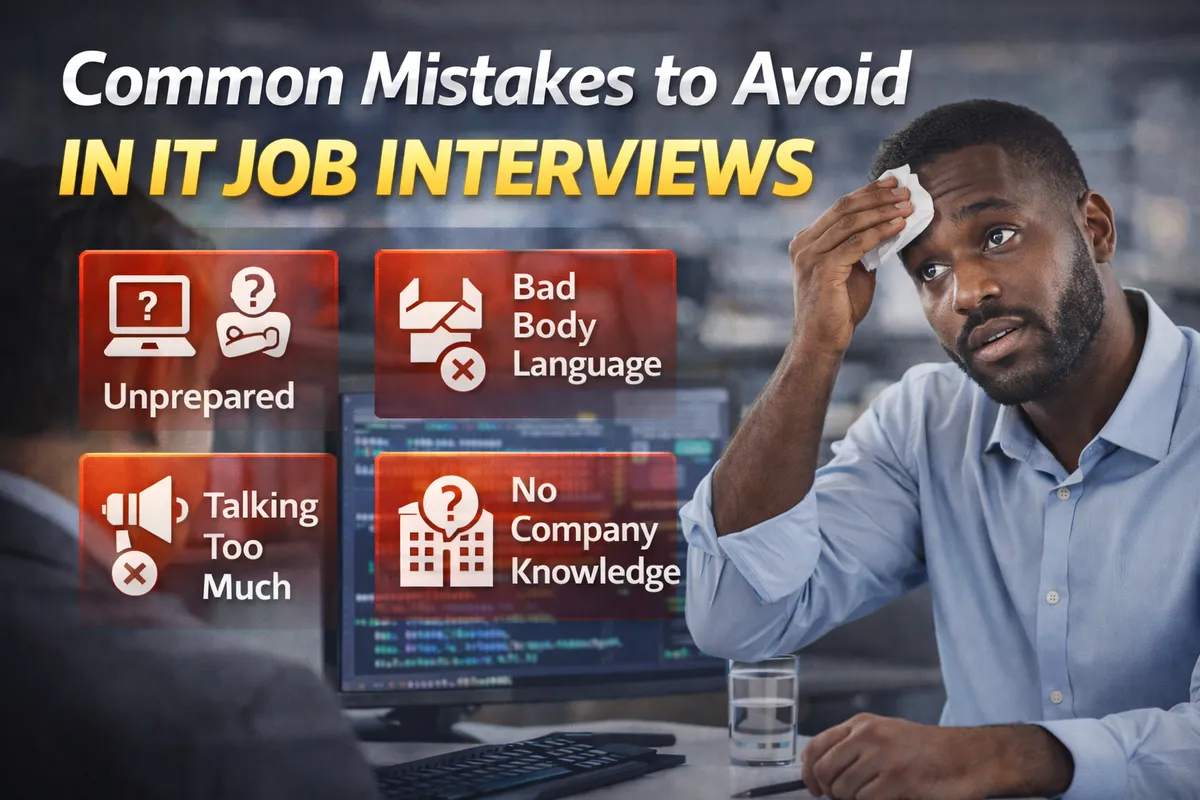
Common Mistakes to Avoid in IT Job Interviews
Nearly half of all candidates fail interviews because of avoidable mistakes, not lack of skill. Learn the most common errors in IT interviews and how to fix them before your next one.